When you became a mother** for the first time, how did you feel? Were you excited about this new chapter, or did you feel scared, confused, or all of the above?
Did you have moments of wishing for your old life back? Moments of thinking, This is not what I expected. Moments of loving your child completely while also grieving parts of your life before baby?
If you did, I want you to know that any or all of those feelings are normal.
Because you are navigating one of the most significant identity transitions a person can experience. And if you’re living with postpartum ADHD, or maybe discovering your ADHD for the first time after becoming a mother, that transition can feel even more confusing.
But not many people talk about it. I mean, at your 6-week postpartum appointment, did your doctor ask you how your transition into motherhood was going? Did they ask how your identity was changing or whether you had started wondering who you are now? If the answer is yes, I love your doctor, but it isn’t common.
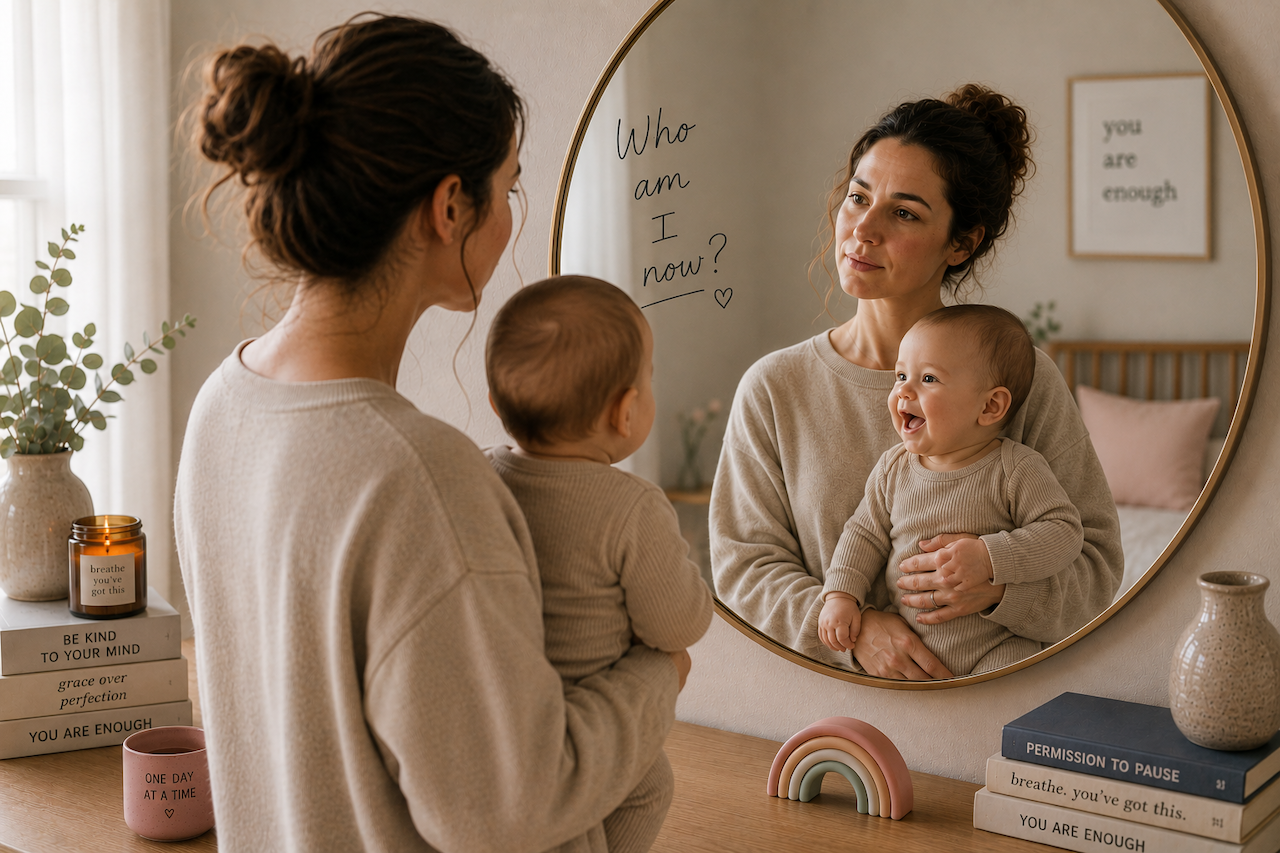
When I became a mother for the first time, although not yet diagnosed with ADHD, I remember asking myself, “Who am I now?” “Is this what motherhood really looks like?”
Transitions are difficult for many people with ADHD, and becoming a mother or parent is a doozy! That’s not to say it isn’t difficult for mothers without ADHD, because it is.
But ADHD adds another layer to an already profound transformation.
Did you know this transition has a name?
It is called matrescence, and it is not a word most people know. Yet it’s actually considered another developmental stage in life.
The term matrescence was first coined by medical anthropologist Dana Raphael in the 1970s to describe the transition into motherhood. Similar to adolescence, matrescence refers to the profound physical, emotional, psychological, social, and identity changes that occur as a woman becomes a mother.
More recently, psychologist Dr. Aurélie Athan expanded the concept, helping bring greater awareness to motherhood as a major developmental life transition rather than a simple role change.
Much like adolescence, it often involves a period where the old identity has not fully dissolved, and the new identity has not yet fully formed.
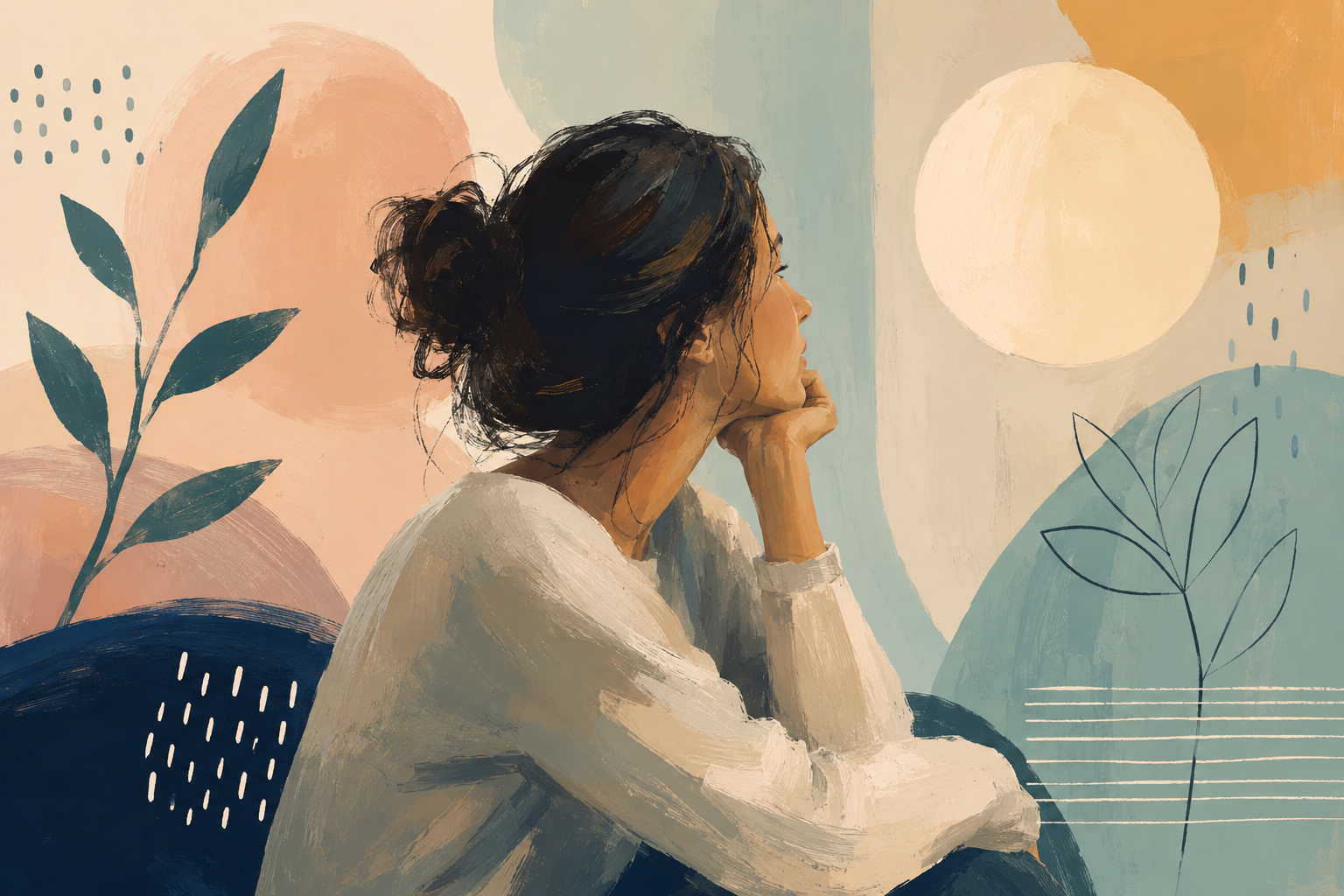
What you are experiencing, or have experienced, is being in the in-between.
And on top of it, the world expects you to function as though nothing fundamental has changed, when in reality, nearly every aspect of your life has. Your body, brain, emotions, relationships, your roles, your sense of purpose, and even your sense of who you are.
So, if you feel like you are falling apart, you aren’t. You are in the middle of one of the most significant identity shifts a person can experience.
The reason this word matters is that it reframes everything.
You’re not simply adjusting to having a baby… you’re also adjusting to becoming a mother.
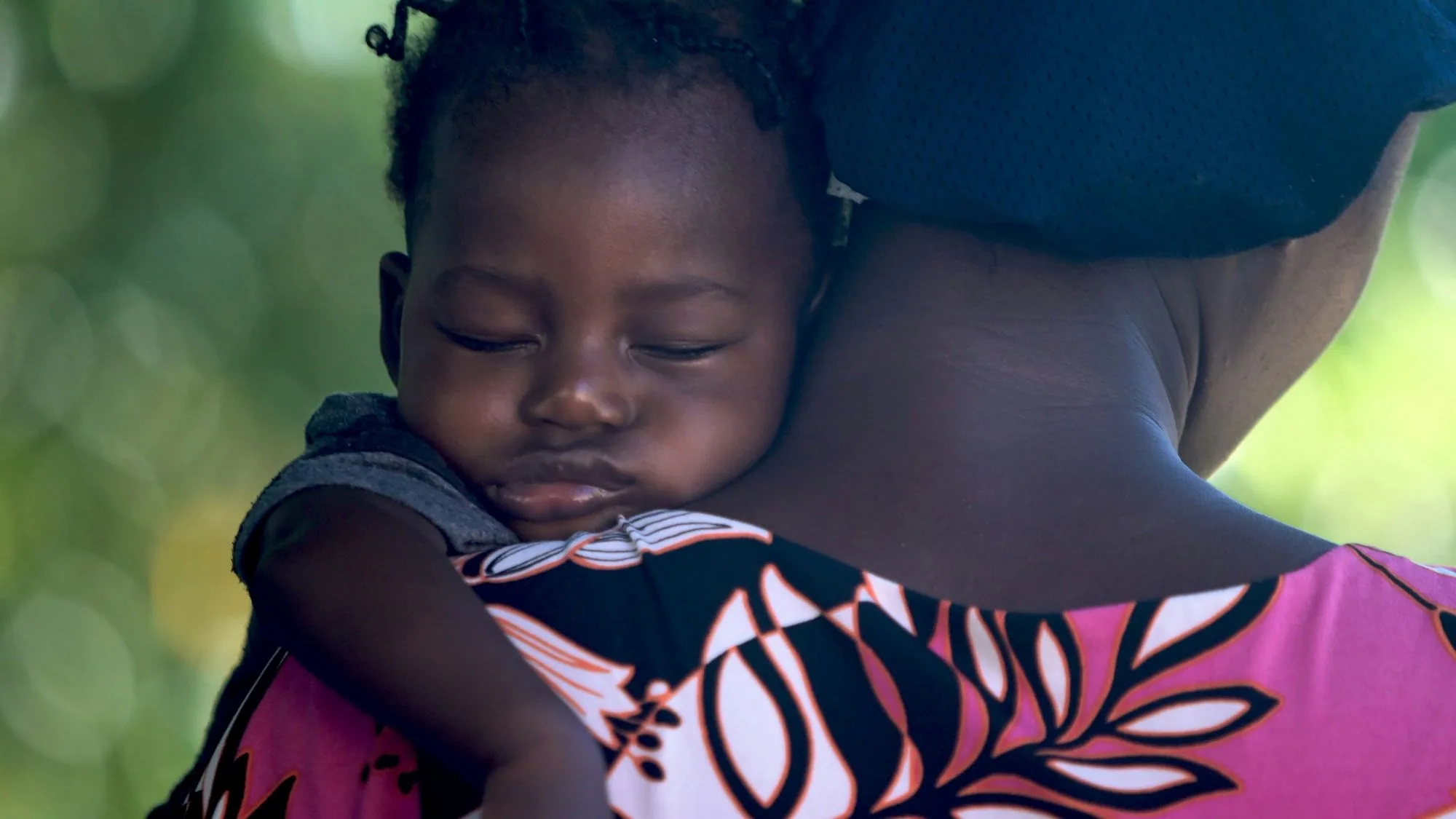
“Birth is not only about making babies. Birth is about making mothers.” — Barbara Katz Rothman
What you may have been calling failure, the confusion, shock, loneliness, overwhelm, or loss of self, is often evidence that the transition is real.
So, really, you are becoming. And becoming takes time.
Grief is a big part of this transition.
Grieving does not mean you do not love your child. But your life has changed in a genuine and fundamental way. People may have said things like, “Your life will never be the same once you have a child” during pregnancy, but you can’t really know what that means until your baby is here.
You grieve the freedom you once had, the spontaneity, the quiet, and the ability to leave the house without planning every detail. And it is the version of you that you are most familiar with.
Some parts of that life will return, especially if these parts are important to you, but some may not.
And some parts of yourself may grow in ways you never could have imagined before becoming a mother.
Yet many mothers feel guilty acknowledging the loss.
Sitting with clients, I often hear …
- “I should be grateful.”
- “I shouldn’t feel this way.”
- “Other moms seem happy.”
- “What kind of mother misses her old life?”
- “I was so excited to be a mom. What is wrong with me?”
The shame that sits on top of this grief can be even more painful than the grief itself.
But grieving your previous life is normal.
And you can love your child with everything you have and still miss parts of your life before motherhood.
Both things can be true at the same time.
One of the most common things I hear from mothers, and something I experienced myself, is that motherhood was not what they expected. The version of motherhood many of us imagined (and the one our culture often sells us) is very different from the reality.
We are prepared for the practical changes. We expect sleepless nights, diaper changes, feeding schedules, and learning how to care for a baby.
What many of us are not prepared for is the transformation of ourselves.
That we may question our purpose, our value, or even our identity. That we may look in the mirror and wonder, Who am I now?
They are often signs that matrescence is unfolding.
Motherhood isn’t simply about learning how to raise a child. It is also about becoming someone new while trying to hold onto the parts of yourself that matter most.
When Motherhood Changes Where You Find Your Value
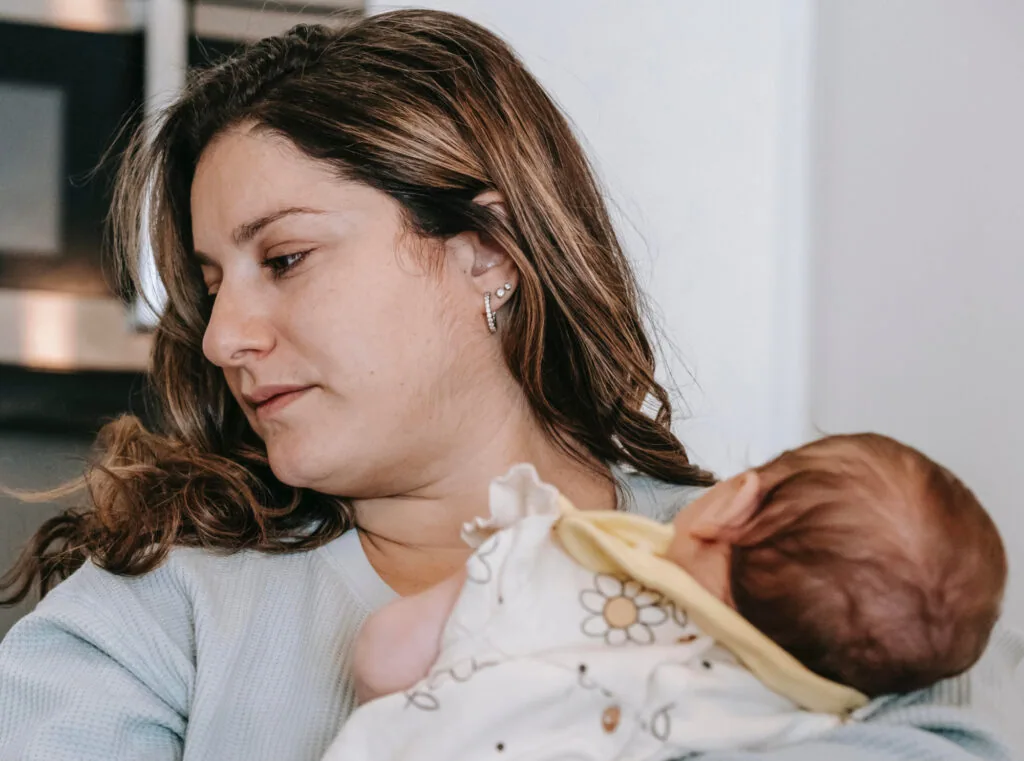
As I mentioned earlier, one of the questions I found myself asking after becoming a mother was, “Who am I now? “But underneath that question was another one that felt even more painful and familiar, “Is this really how I have value?”
Before motherhood, many women with ADHD (and without) receive feedback about who they are through what they do.
Maybe it comes through achievement, work, helping others, creativity, or problem-solving. And one thing our culture is very much about is productivity.
There are markers that tell you that you matter.
- You finish a project.
- You solve a problem.
- You receive praise.
- You accomplish something.
Then motherhood arrives.
Suddenly, much of your day is spent doing work that is essential but largely invisible and boring. And because people with ADHD have an interest-based nervous system, the day-to-day of motherhood can feel like an existential crisis.
The baby needs to be fed again.
The dishes need to be washed again.
The toys need to be picked up again.
The laundry is never finished.
The needs never stop.
For many moms with postpartum ADHD, this shift can feel profoundly disorienting.
The activities that once provided stimulation, novelty, accomplishment, and external feedback may be reduced or disappear altogether.
In their place is work that is repetitive, relentless, and often unnoticed.
This does not mean motherhood is meaningless.
But it can feel that way when your brain has spent years associating value with productivity.
For many women, part of matrescence is grieving not only who they were before children but also the ways they understood their worth.
The invitation is not to abandon the parts of yourself that existed before motherhood.
It is to expand your identity.
To learn that your value is not measured solely by what you produce, achieve, accomplish, or check off a list.
That process takes time.
Why Is This Experience Harder with Postpartum ADHD?
Before we talk about ADHD, I want to repeat that matrescence is disorienting for every mother.
But if you’re living with postpartum ADHD, that transition can feel even more overwhelming.
For many women, the postpartum period is when they are first diagnosed with ADHD. Not because motherhood causes ADHD, but because it often reveals it.
Before becoming a mother, you may have unknowingly managed your ADHD through perfectionism, overpreparing, people-pleasing, anxiety, or sheer determination. Then motherhood arrives, and the systems that once helped you cope are stretched beyond their limits.
Sleep becomes unpredictable, hormones shift dramatically, your routines disappear, and your attention is constantly pulled in different directions by your baby’s needs.
Motherhood places enormous demands on the very executive functions that ADHD already makes more challenging. These are planning, organization, working memory, task initiation, emotional regulation, self-regulation, and cognitive flexibility. Tasks that once felt manageable may suddenly feel impossible.
Many women describe this as feeling like they are falling apart. But often, they aren’t falling apart at all.
They’re reaching the limits of the coping strategies that helped them get this far.
The high achiever, the organized one, the dependable one, and the perfectionist. The woman who always figured it out.
Those identities weren’t simply personality traits. They were often ways of compensating for ADHD.
Motherhood asks more of those systems than they can sustainably provide, making it feel as though you’ve suddenly changed, when in reality your ADHD has become much harder to mask.
What feels like “why can’t I keep up” is often the moment those coping strategies reach their limit.
The Sensory Side of Postpartum ADHD and Motherhood
When people think about ADHD, they often think about distractibility, forgetfulness, or difficulty staying organized.
What gets talked about far less is the nervous system.

For many mothers experiencing postpartum ADHD symptoms or navigating motherhood with previously diagnosed ADHD, the challenge is not only mental, it is also about sensory sensitivity.
- The crying
- The noise
- The clutter
- The constant interruptions
- Feeling touched out
- The endless shifting of attention from one need to the next
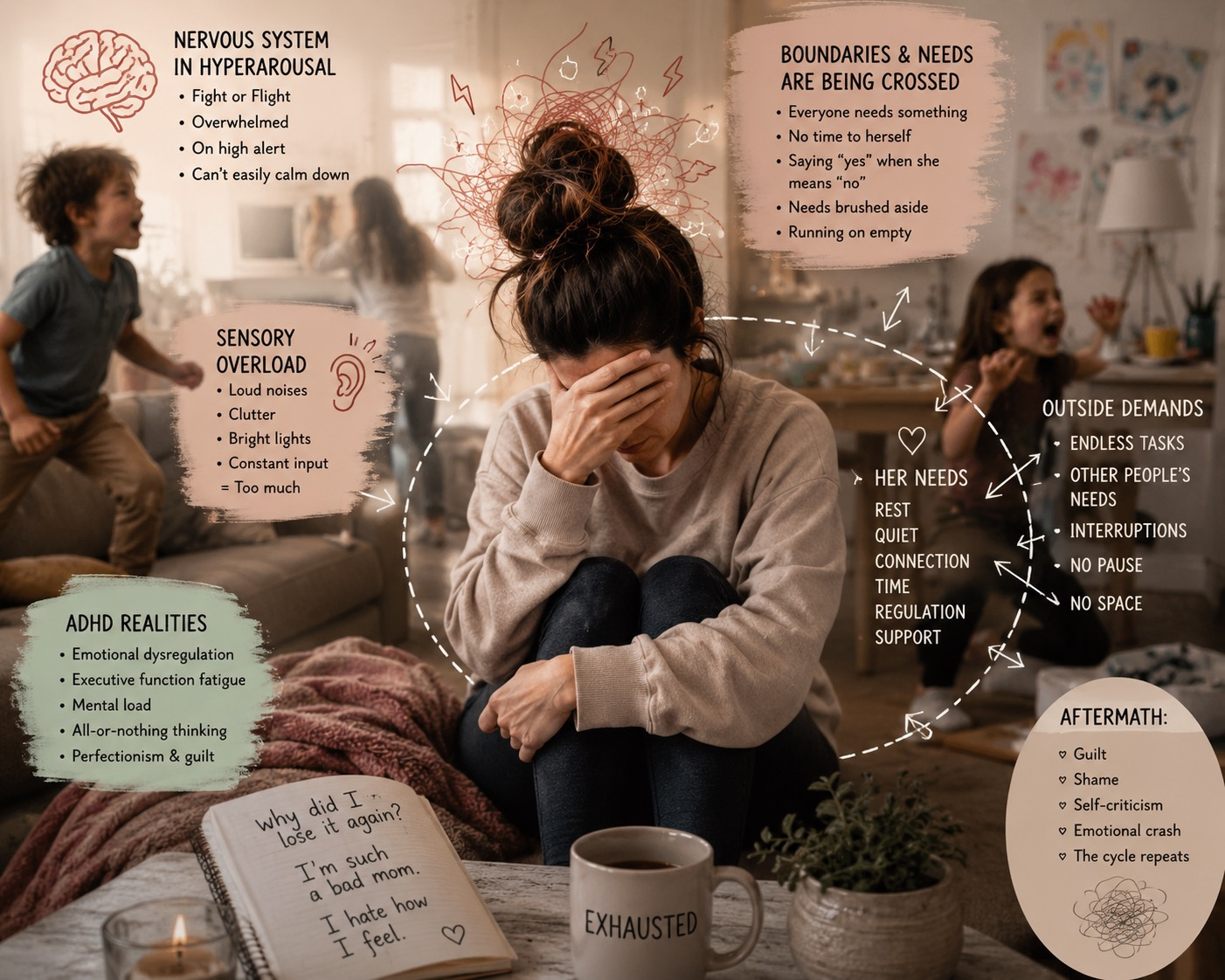
This kind of sensory input has been accumulating since you opened your eyes. And many moms with postpartum ADHD become overstimulated long before they recognize what is happening.
They become more easily irritable, emotionally reactive, and withdrawn. Desperate for a few minutes of silence.
This is not because they are bad mothers who can’t handle motherhood. It is because their nervous system is receiving more input more quickly than it can comfortably process.
When ADHD and the normal demands of motherhood intersect, emotional dysregulation often follows.
What looks like impatience, anger, or ADHD mom rage is often a nervous system signaling that it has reached capacity.
Sometimes it is not a single difficult moment that causes the reaction, but hundreds of moments that accumulate throughout the day.
You Are in the Middle of Becoming
Matrescence doesn’t have a finish line. It unfolds over time, often in ways you don’t recognize until you look back.
If you’re in the middle of wondering who you are now, you’re not alone. And you’re not doing motherhood wrong.
Understanding what is happening can change how you experience it.
Instead of believing you’re failing, you begin to recognize that you’re navigating one of life’s biggest developmental transitions. Instead of criticizing yourself for struggling, you can begin to offer yourself the same compassion you would offer another mother.
And if you have ADHD, you can recognize that you’re not simply adjusting to motherhood, you’re doing so with a brain that is working much harder to meet the demands of this season. It also takes a village to care for you and your baby. Asking for help can relieve some of the demands.
You may still grieve parts of the life you had before becoming a mother. You may still miss the freedom, predictability, or version of yourself that once felt familiar. Grief and gratitude can exist together. Missing your old life doesn’t mean you love your child any less.
Over time, many mothers discover that the goal isn’t to become the woman they were before.
It’s to become the woman they are now.
One who carries pieces of her old self forward while making room for the new parts of herself that motherhood has uncovered.
The question isn’t whether you’ve lost yourself.
The question is who you’re becoming.
Perhaps you haven’t lost yourself at all. Perhaps you’re in the middle of becoming someone you haven’t had the chance to know yet. And that story is still being written.
**Although I’m using the word “mother” throughout this article because matrescence specifically describes the transition into motherhood, I recognize that every family’s journey is unique. Whether you became a parent through birth, surrogacy, adoption, or another path, many of these questions about identity and purpose may resonate with you.
Jacqueline V. Cohen, LPC, ADHD-CCSP, is a licensed therapist who specializes in the intersection of perinatal mental health and adult ADHD. To learn more about her work, visit her website. You may also contact her by email.