

If you are a mom and have ADHD, experiencing moments of rage doesn’t mean you are a bad mom who can’t handle motherhood. ADHD mom rage is a real and common experience. And if you are living it, you already know how awful it feels. When it comes out of nowhere or feels completely out of your control, it can be scary. And the shame that follows can feel even more destabilizing than the rage itself.
It is important that you know there are real reasons this is happening. There are biological reasons, because a mom with ADHD’s nervous system does exactly what ADHD nervous systems do when they are pushed past their limit.
And there are relational ones, which are the needs that the people around you dismiss. And the needs you have learned to dismiss in yourself.
But first, I want to discuss maternal rage. Many moms with or without ADHD experience it.
What is maternal rage?
Maternal rage is the intense anger and sometimes an explosion that mothers experience as part of their journey through motherhood. It is not the same as everyday frustration or a bad day. It is a deeper, sometimes overwhelming anger that can feel completely disproportionate to what is happening in the moment, followed by intense shame. This is what makes it so confusing and so hard to talk about.
Anger is loaded with information and energy. Audre Lorde
But it is important to talk about, so here we go…
What triggers maternal rage matters. Sometimes it is the feeling of powerlessness, of your needs being pushed aside, and a role that asks everything of you while leaving no room for you inside it.
Sometimes it is the gap between what motherhood was supposed to look like and what it actually feels like on a Tuesday at noon when you have not finished a single thought since you woke up.
For moms with ADHD, all of these triggers land harder and faster than for mothers without it.
Here is why ADHD adds an additional layer:
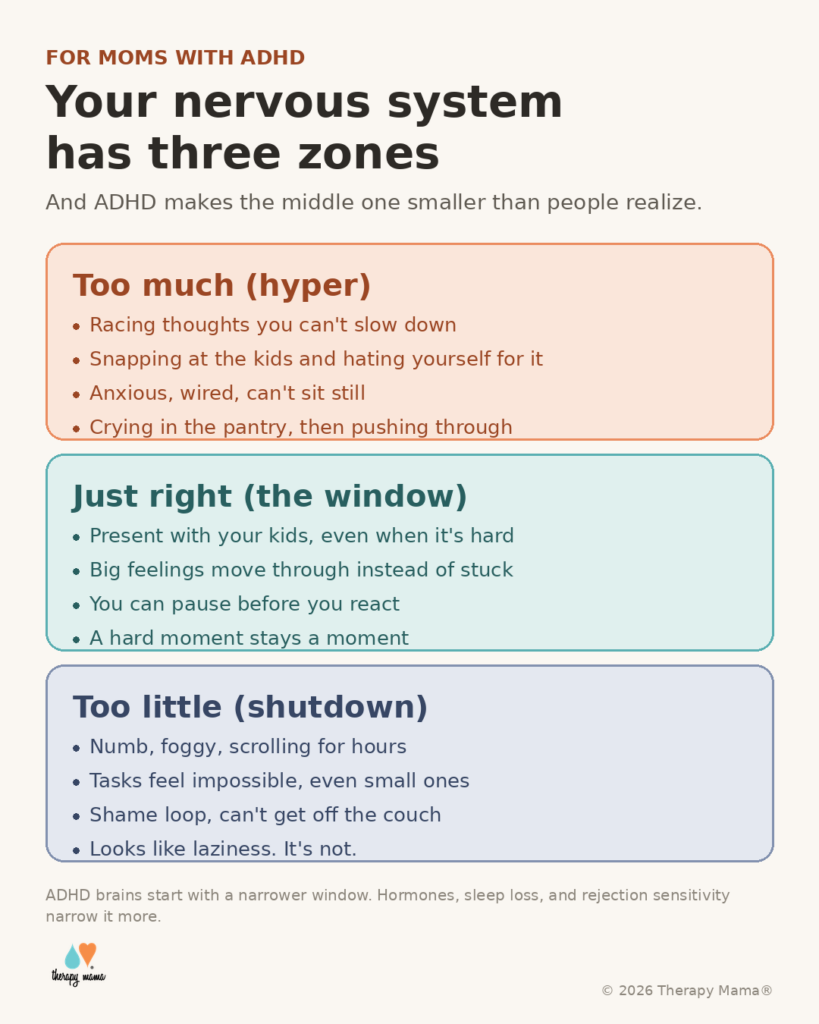
Shorter Window of Tolerance
Moms with ADHD have a shorter window between manageable and overwhelmed.
All parents (and children) have a window of tolerance. It is the time in your day when you are regulated, can think more clearly, make good decisions, and so on. A window of tolerance is different for everyone, and factors like sleep, hydration, nutrition, and self-care practices can widen it. If these things are lacking, it can shorten the window.
And the maternal rage, whether it is quiet or explosive, is often the first sign that the window has closed.
The Role of Sensory Overload
The ADHD brain processes sensory input differently. Touch, sound, noise, and stimulation all arrive at a higher intensity.
Motherhood is relentless sensory input.
The crying, the noise, the constant questions, the physical touch, the clutter, and the unpredictability of family life can place a tremendous burden on a nervous system that is more sensitive to sensory input.
By the end of the day, it may seem like a small trigger caused a big reaction, but in reality, the sensory input and mental demands have been accumulating since the moment she opened her eyes that morning.
This kind of sustained overload can push the system to a place where rage, whether quiet or explosive, is the only release left.
Emotion Dysregulation is a Symptom of ADHD
Many mothers with ADHD find themselves becoming emotionally dysregulated more quickly than they expected. This is often the result of how ADHD affects executive functioning, attention regulation, and sensory processing.
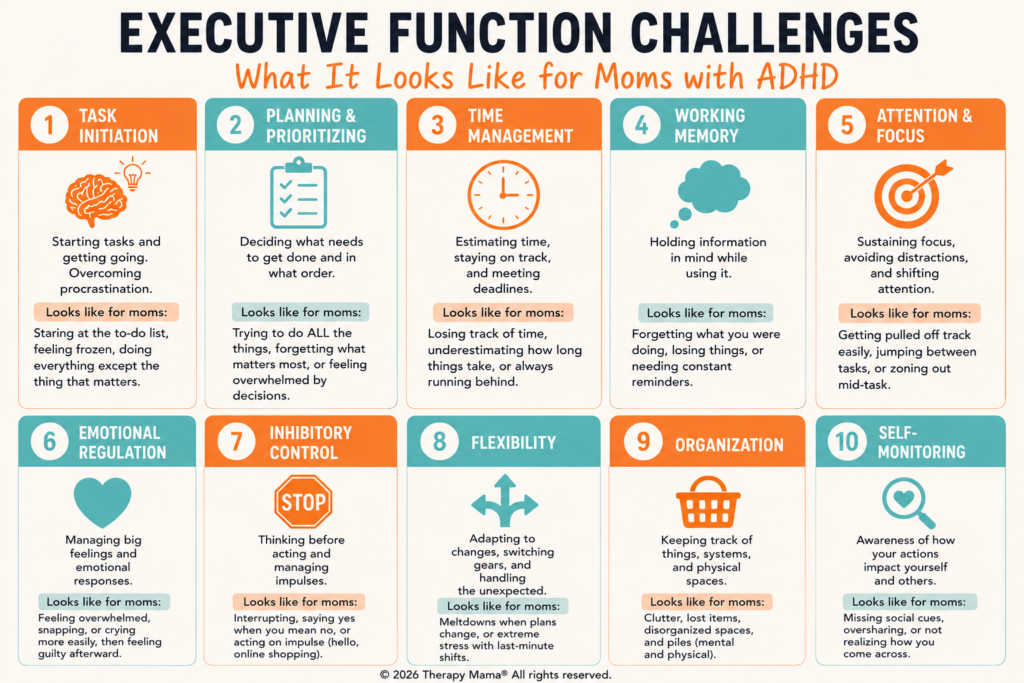
Throughout the day, a mother with ADHD is constantly shifting her attention to meet the needs of her children. For people with ADHD, shifting attention takes more mental and physical energy than for people without it.
Let me give you an example I heard at an ADHD conference that stuck with me. If you have a child with ADHD and a child without ADHD sitting in school, it takes the child with ADHD 7 -10 times more mental and physical energy in a school day than the child without it.
That principle does not stop at childhood. The same brain that took seven to ten times more energy to get through a school day is now the brain you are using to get through motherhood. Every load you carry, every task you switch between, every moment you regulate yourself in front of your kids, all of it is costing you significantly more than it costs a neurotypical mom doing the same thing.
Every day, you are interrupted dozens of times, pulled away from tasks before they are finished, and expected to rapidly transition from one demand to the next. Each shift requires mental and physical energy. Over time, those demands can tax an already overworked executive functioning system.
What looks like an emotional outburst is often the result of a nervous system that has reached its capacity. Understanding this can help mothers move away from shame and toward strategies that support regulation, recovery, and self-compassion. Here is something that might reframe everything for you.
The explosion did not come from nowhere. It came from hours of accumulated overload that had no outlet.
Shame, RSD and the Perfect Mother Myth
Here is where ADHD mom rage gets its particular cruelty.
Most moms feel some guilt after a moment of rage. But for moms with ADHD, the guilt and shame that follow can be crushing in a way that goes beyond the moment. That is partly because of something called Rejection Sensitive Dysphoria, or RSD.
RSD is a feature of ADHD that causes intense emotional pain in response to the perception of failure, criticism, or not measuring up. It is not just feeling bad. It feels like the worst version of yourself is confirmed.
And when the thing you perceive yourself as failing at is motherhood, the role that comes loaded with more expectations than almost any other, RSD can take one hard moment and turn it into evidence that you are fundamentally not enough.
Shame also gets tangled up with something most of us absorb long before we become mothers… the myth of the perfect mom. The mom who is endlessly patient, never raises her voice, whose children are her greatest joy every single moment, and who would never, ever lose it.
That mother does not exist, nor has she ever existed.
But the myth is powerful, and when you are standing in your kitchen after a blowup, the myth is what you measure yourself against.
And for many, especially if you are late diagnosed, underneath that shame is something older. A voice you have been hearing for most of your life that says you are not trying hard enough. That if you just had more discipline and patience, this would not have happened. A teacher, a parent, or someone who saw you struggling may have told you this because they decided the problem was effort rather than neurology.
I want you to know that voice is not the truth. It never was. But it is loud, and it knows exactly when to show up.
The good news is that there are things you can do that can help.
What You Can Actually Do
You don’t need to try harder! But you can…
• Know your window.
Pay attention to what depletes you fastest in your day and what, if anything, helps you reset. You can’t always control what happens, but you can start to notice the pattern of how you get to overload, and sometimes that is enough to create a small pause before you hit your threshold.
• Understand that sensory overload is real, and it is manageable when it is recognized.
That means looking honestly at what in your day is flooding your nervous system and whether any of it can be reduced, handed off, or structured differently.
• Try not to over-identify with what you are feeling, because you aren’t what you feel.
Just acknowledge, ” I am overwhelmed and past my limit. I need a minute.”
That kind of naming creates just enough distance between the feeling and the reaction to give you a choice.
• Allow yourself to be human.
You are allowed to struggle. And motherhood isn’t easy for anyone. Having moments where you want everything to stop is normal. That does not cancel out the love. It means you are doing something genuinely hard without enough support.
• The shame is not the truth.
The voice that says you are not trying hard enough is old and it is wrong. Rage that comes from overload is not a moral failure. It is information about what you need.
• Talk to someone who understands both ADHD and perinatal mental health.
If the rage is frequent, if the shame afterward is consuming, if you feel like you are cycling through this without any way out, please do not wait. This is treatable. You do not have to keep managing it alone.
If you see yourself in any of this, I want you to know this experience is more common than you think. The moms who sit across from me feel exactly what you are feeling. And they found their way through it. Not by being better or trying harder, but by finally understanding what was actually happening and getting support that met them where they were.
You deserve that too!
Jacqueline V. Cohen, LPC, ADHD-CCSP, is a licensed therapist who specializes in perinatal mental health and adult ADHD. To learn more about her work, visit her website. You may also contact her by email.
Get your free copy of my e-book: Motherhood and ADHD
You will also receive a subscription to my newsletter.